Last Updated: June 24, 2026
Did you know why most of the RPM programs fail before they even begin?
Well, the answer behind it is not technology. Many clinicians overlooked very small but critical steps in between onboarding a patient and submitting the first claim. It’s consent. This means denied claims, compliance issues, and revenue slipping through the cracks.
Before starting billing, you must align with the Centers for Medicare and Medicaid Services (CMS) guidelines. If you fail to document your patient’s consent, it can ultimately lead to denied claims and audit risks.
Till here, you might have understood that consent is not just a formality. While the RPM patient enrollment process brings your patients into the program, consent, on the other hand, helps to ensure that your patients understand the services, data use, and potential costs.
All these factors together shape remote patient monitoring consent requirements and set the compliance tone.
This blog will guide you about CMS RPM patient consent guidelines by explaining how to document patient consent for remote patient monitoring, key enrollment rules, and verbal vs written consent for Medicare RPM services.
CMS Consent Requirements and What Must Be Disclosed

The CMS requires providers to take patient consent before starting RPM services. This step is a core part of RPM patient consent requirements, and if you skip this step, it can directly affect your billing ability.
Here, one thing you should know is consent is not just about getting a “yes.” It is necessary to inform your patients clearly about what they’re signing up for. It may include the nature and purpose of RPM services, how their health data will be collected, used, and possibly shared, and any cost-sharing responsibilities like Medicare co-insurance.
Along with all these, equally important is patients’ understanding of rights, including the ability to opt out at any time. As per CMS RPM patient consent guidelines, you can take either verbal or written consent.
However, beyond format, one thing that can create major issues is documentation. Consent must be properly documented in the patient’s medical record before billing begins. If you get it correctly, it ensures that your remote patient monitoring consent requirements are met fully.
Verbal vs Written Consent: What Providers Should Use
One common point of confusion in RPM patient consent requirements is whether to rely on verbal or written consent, as both are allowed under CMS guidelines. However, the real difference lies in how well each option works during audits and day-to-day operations.
Let’s compare Verbal vs Written Consent:
| Aspect | Verbal Consent | Written Consent |
|---|---|---|
| CMS Acceptance | Allowed under Medicare | Allowed and widely preferred |
| Documentation Requirement | Must include date, time, and details of the discussion in the medical record | Signed form stored in patient record |
| Audit Protection | Moderate (depends on documentation quality) | Strong (clear proof of consent) |
| Ease of Collection | Faster, can be done during patient interaction | Requires forms and signatures |
| Best Use Case | Initial enrollment or quick onboarding | Long-term documentation and compliance |
RPM Patient Enrollment Process: From Eligibility to Activation
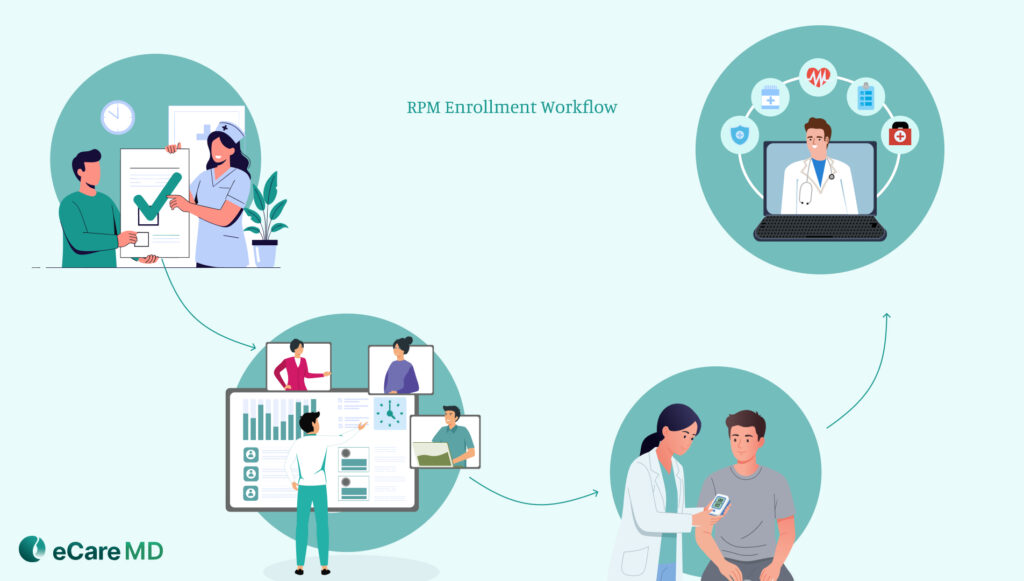
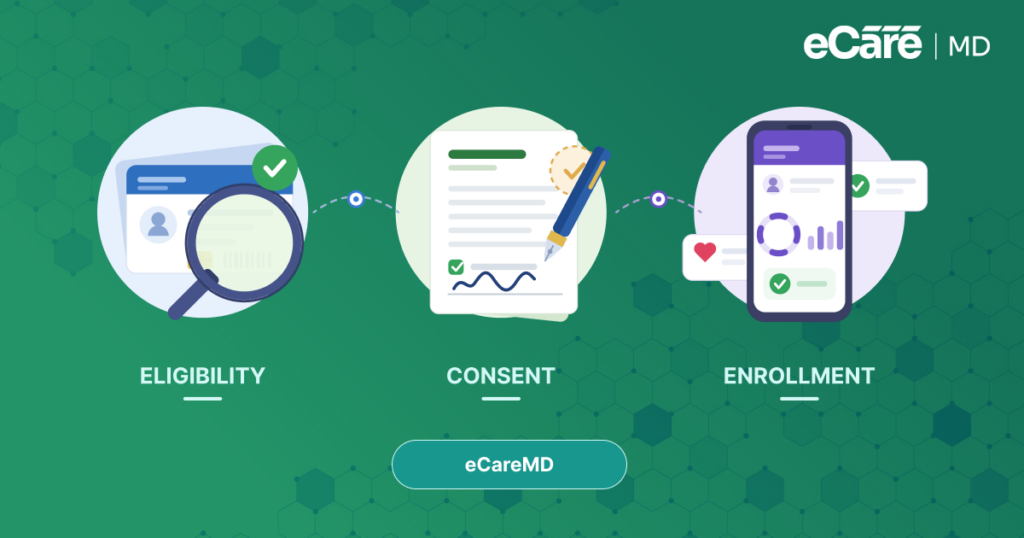
The next step after obtaining patient consent is moving your patients through a clear and structured RPM patient enrollment process. This is where compliance and operations come together, making this step critical. If the process is inconsistent, you will face errors while missing requirements.
Let’s have a look at how a typical and compliant enrollment process works:
- Identify eligible patients based on clinical conditions that can benefit from RPM (e.g., chronic conditions requiring continuous monitoring).
- Confirm the established patient requirement and initiate the visit, as required by the CMS under medicare rpm enrollment rules.
- Educate patients about RPM services, including how monitoring works and what is expected from them.
- Obtain and document consent in line with RPM patient consent requirements before starting services.
- Enroll the patient and initiate monitoring, ensuring devices and data transmission are set up correctly.
When these steps are followed by a structured workflow, it can reduce your operational errors while keeping your remote patient monitoring consent requirements aligned with compliance.
Documentation Requirements for Audit-Ready Compliance
Along with obtaining consent, documenting is equally important. As per remote patient consent requirements, if you do not record consent properly, it can create problems in audits, which can further lead to denied claims. In simple terms, documentation is your safety net.
Your records should include:
- Date and type of consent (verbal or written).
- Summary of the patient discussion, covering services, data use, and costs.
- Patient acknowledgment, confirming they agreed to participate.
Additionally, consent should be easy to retrieve within the patient’s medical record. Buried in notes or scattered across systems is not counted. This is especially important when following broader references like the CMS MLN and Physician Fee Schedule.
Avoiding Mistakes and Building a Compliant Enrollment Workflow

Every coin has two sides; just like that, if you overlook small gaps, even a strong RPM program can run into compliance issues. These small mistakes can quickly result in denied claims or audit risks.
Let’s have a look at common mistakes with their implementation key:
1. Missing or incomplete consent documentation:
This mistake happens when your team assures that consent was captured but fails to record all required details. During audit time, incomplete documentation is treated the same as no consent at all.
Let’s see the solution now:
- Standardization of your documentation process.
- Ensuring every consent entry involves the consent type, date, time, and discussion summary.
- All these are stored in an easily retrievable format.
2. Obtaining consent after services have started:
In this constantly changing environment, it’s easy to start monitoring before documenting your patient’s formal consent. But this is actually against compliance expectations and can result in denied claims.
Let’s see the solution now:
Building checkpoints into your workflows so that RPM services cannot start until consent is obtained and recorded properly. This further helps to keep you aligned with the CMS requirements.
3. Duplicate enrollment across providers:
This is one of the common challenges that usually happens when you unknowingly enroll the same patient. This can lead to billing conflicts and confusion in care coordination.
Let’s see the solution now:
Creating clear enrollment ownership rules and using centralized systems for tracking your patients’ status can help you ensure that you enroll only one active RPM patient.
Download Free Guide - Care Coordination Software Cost Estimation Tool for Your RPM Program
Download NowConclusion: Building a Compliance-First RPM Program
A strong RPM program doesn’t start with devices; it starts with getting consent and enrollment right. When remote patient consent requirements are handled properly, and the RPM patient enrollment process is structured, everything else, from billing to compliance, falls into place more smoothly.
Aligned with guidance from the Centers for Medicare & Medicaid Services, this approach helps reduce risk, prevent claim denials, and protect your revenue as your program grows. It’s the difference between a program that struggles to keep up and one that scales with confidence.
Want to make it easier? Click here to simplify your RPM enrollment workflow and stay compliant from day one.
Frequently Asked Question’s
Under guidelines from the Centers for Medicare & Medicaid Services, providers must obtain patient consent before starting RPM services. Patients should be clearly informed about the nature of services, how their data will be used, any cost-sharing responsibilities, and their right to opt out. Proper documentation of this consent is essential to meet rpm patient consent requirements and support billing.
Yes, verbal consent is allowed under CMS RPM patient consent guidelines. However, it must be documented in the patient’s medical record with details like the date, time, and summary of the discussion to remain compliant.
Verbal consent is quicker to obtain and can be recorded during patient interaction, but it relies heavily on accurate documentation. Written consent, on the other hand, provides stronger audit protection since it includes a signed record. Both are valid, but written consent is often preferred for long-term compliance.
The medicare rpm enrollment rules require that patients meet eligibility criteria, have an established relationship with the provider, and complete an initiating visit if needed. Consent must be obtained before enrollment, making the rpm patient enrollment process both a clinical and compliance step.
To meet remote patient monitoring consent requirements, documentation should include the type of consent (verbal or written), date, time, details of the discussion, and patient acknowledgment. This ensures clarity and audit readiness.
Consent must be obtained before RPM services begin. If it’s collected after monitoring starts, it may not meet CMS requirements and could lead to claim denials.
Common issues include missing or incomplete documentation, obtaining consent after services have started, and duplicate patient enrollment across providers. These gaps can affect compliance and reimbursement.
No, billing without documented consent does not meet rpm patient consent requirements. Even if consent was verbally given, lack of proper documentation can result in denied claims or audit risks.
Yes, in most cases, CMS expects an established patient relationship before initiating RPM services. This is typically confirmed through an initiating visit, ensuring the patient is appropriately evaluated before enrollment.

























![The Future of Remote Patient Monitoring: CMS Innovations & Emerging Trends [2026]](/wp-content/uploads/2024/07/Blog-36-The-Future-of-Remote-Patient-Monitoring_-Trends-AI-Innovation-CMS-Updates-for-2026-1024x538.png)